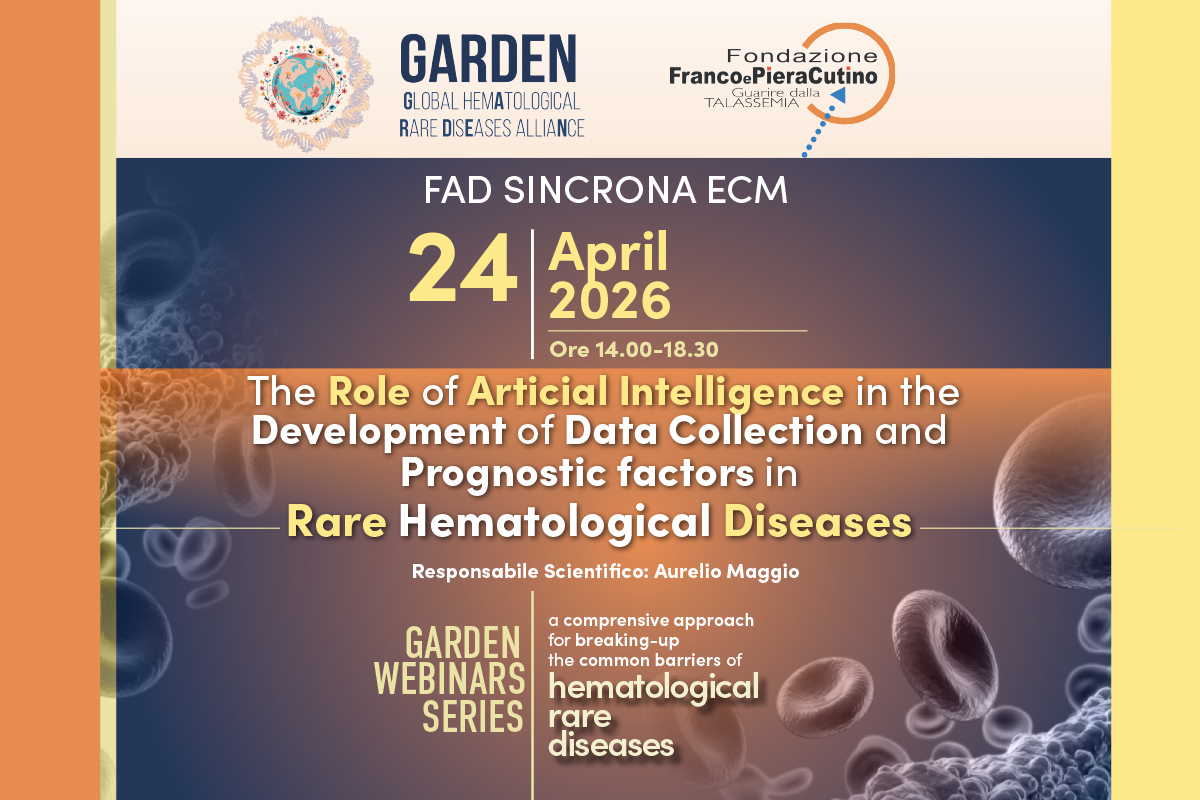
The role of artificial intelligence in the development of data collection and prognostic factors in rare hematological diseases
RAZIONALE
Rare hematological diseases, although individually uncommon, collectively affect millions of people worldwide. They share major challenges such as delayed diagnosis, limited access to treatments, and the need for effective patient communication. Addressing these issues requires a multidisciplinary and international network committed to building a shared framework for action. The rapid evolution of therapies demands continuous education for healthcare professionals.
This event is part of the GARDEN Network CME Webinar Series focusing on key areas of recent progress:
- Hemophilia: Updates on real-world evidence and international consensus on prophylaxis and treatment to ensure consistent standards of care;
- Thalassemia and MDS: Insights into the real-life use of luspatercept and its role in improving outcomes and safety across patient populations;
- PK Deficiency, Thalassemia, and SCD: A comparative view on mitapivat and etavopivat as targeted therapies across different rare red cell disorders;
- TTP: Challenges in real-life diagnosis and management of this hematological emergency;
- PNH: Advances in available treatments and ongoing barriers linked to cost and access;
- GENE THERAPY: Real-world evidence from European experience, marking its arrival at the patient’s bedside;
- AI: Exploring new AI tools to enhance clinical data collection and support future clinical trials in rare hematological diseases.
Artificial Intelligence (AI) is becoming an essential tool in medical research, offering unprecedented opportunities in data management, pattern recognition, and the development of prognostic models.
In the field of rare hematological diseases — where small patient populations and fragmented data pose significant challenges — AI can support clinicians and researchers in improving diagnosis, refining prognostic factors, and enhancing patient outcomes. This educational event will bring together international experts to present the current state of AI applications in hematology, share real-world experiences, and discuss the ethical and practical aspects of integrating AI into clinical research. A specific focus will be devoted to the role of AI in advancing a new vision of thalassemia as a benign disorder of hematopoietic stem cells (HSCs). Through AI-assisted literature review and the creation of virtual patient cohorts within the GARDEN Network, it will be possible to strengthen the scientific evidence supporting this concept and to facilitate the design of more robust pharmacological trials. This methodology — already successfully applied to myelodysplastic syndromes — can be extended to other rare hematological diseases, promoting a unified data-driven research model. The ultimate goal of the webinar is to reach a consensus agreement among participants and to lay the foundation for an International GARDEN Consortium dedicated to conducting meta-analyses, building AI-supported virtual cohorts, and driving pharmacological innovation in rare hematological disorders.
ISCRIZIONI ONLINE
Iscrizioni chiuse